


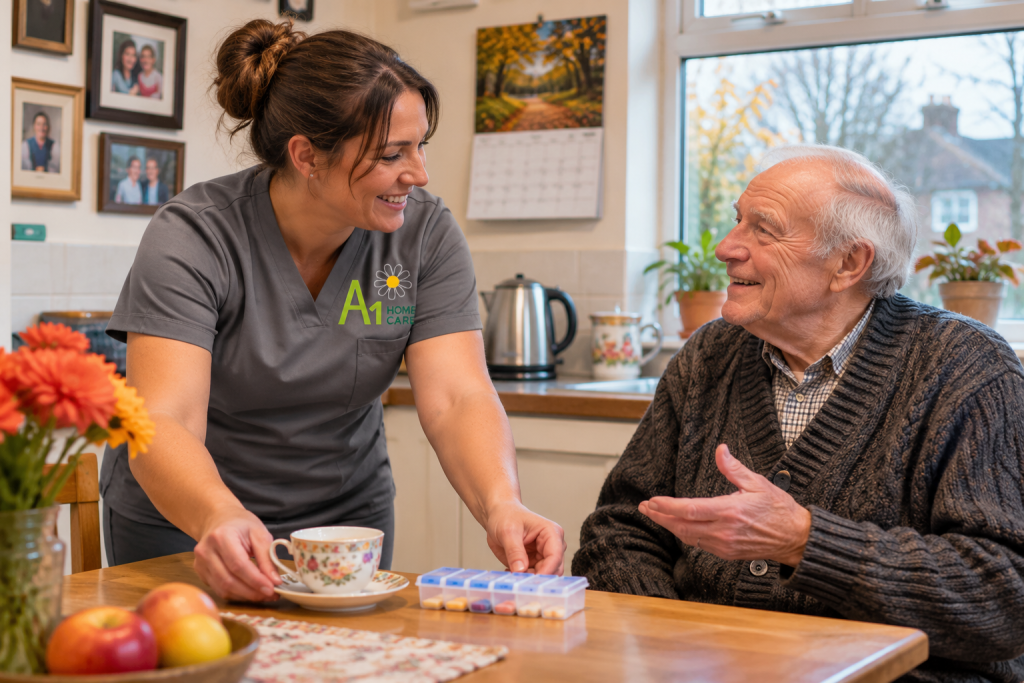
When an older relative starts to find everyday tasks harder, families often come across the term “domiciliary care” and are not always sure what it means. Put simply, domiciliary care is care and support provided in a person’s own home by trained carers who visit at agreed times. You may also hear it called home care.
This guide explains what domiciliary care involves, who it can help, how it compares with moving into a care home, and how to arrange it in Chelmsford.
What Does Domiciliary Care Mean?
The word “domiciliary” simply means “at home”. Instead of moving somewhere new to receive care, the person stays in their own house or flat and carers come to them.
Support is built around the individual. Some people need a short visit each morning to help them get up and dressed, while others need several visits a day, overnight support or care around the clock. Care can range from as little as 30 minutes a day to 24 hours a day, and it can be increased or reduced as needs change.
In England, domiciliary care agencies must be registered with the Care Quality Commission (CQC), which inspects services and publishes ratings so families can check the quality of care before they choose a provider.
Who Can Benefit From Domiciliary Care?
Domiciliary care can help people of all ages, but it is most often used by older people who want to remain independent at home. It can also support:
- People returning home after a stay in hospital
- People living with dementia, Parkinson’s or other long-term conditions
- People with physical disabilities, learning disabilities or sensory impairments
- People recovering from a stroke or an injury
- People who need palliative care and wish to stay at home
- Family carers who need regular support or a short break
What Support Do Carers Provide?
Every care plan is different, but domiciliary care often includes help with:
- Washing, bathing and dressing
- Taking medication at the right times
- Preparing meals and drinks
- Shopping, cleaning, laundry and ironing
- Getting to doctor, dentist and hospital appointments
- Companionship, conversation and trips out
- Sitting and respite services for family carers
- Sleep or awake night care
For older relatives, regular visits can make a real difference to safety, confidence and wellbeing. Our elderly home care in Chelmsford page explains how we support older people to stay comfortable and independent in their own homes.
Domiciliary Care or a Care Home?
Many families weigh up home care against a move into residential care. The main difference is that domiciliary care allows someone to stay in familiar surroundings, keeping their own routines, belongings, neighbours and, in many cases, pets. Each visit is one-to-one, so the carer’s time is focused entirely on that person.
Home care can also be adjusted gradually. Someone might start with a few visits a week and build up support over time, rather than making one large change all at once.
For some people, a care home is the right choice, particularly if they need constant supervision that cannot be arranged safely at home. The best option depends on the person’s needs, wishes and circumstances, and it is worth talking these through as a family.
How Do You Arrange Domiciliary Care in Chelmsford?
Arranging care usually follows a few simple steps:
- Talk about what help is needed. Start with the tasks that have become difficult and what your relative would like to keep doing for themselves.
- Ask about a care needs assessment. If you think your relative may qualify for funded support, Essex County Council can carry out a care needs assessment. A financial assessment then decides whether the council will contribute towards the cost. Many people also choose to arrange care privately.
- Choose a registered provider. Check that the agency is registered with the CQC and look at its latest rating on the CQC website.
- Agree a care plan. A personalised care plan sets out the support, visit times and preferences, and it should be reviewed as needs change.
Domiciliary Care in Chelmsford With A1 Home Care
A1 Home Care is a domiciliary care agency in Chelmsford, registered with the Care Quality Commission and rated ‘Outstanding’ for caring. We cover the whole Chelmsford area, from the city itself to nearby villages and towns including Writtle, Broomfield, Springfield, Great Baddow, Galleywood, Danbury, Boreham, Great Waltham, Stock, South Woodham Ferrers and Witham.
If you are wondering whether domiciliary care could help you or a family member, contact our team to talk through your needs and the support available.